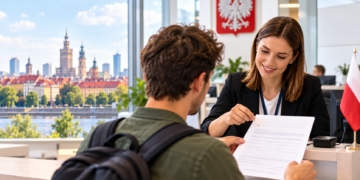


Moving to Poland does not involve one standard visa or residence process. The route depends first on your citizenship, then on how long you intend to stay and what you plan to do in Poland.
An EU citizen moving for work follows a different system from a non-EU employee. A student may need a different permit from a company founder, while the family member of an EU or Polish citizen may have separate rights.
This guide explains the structure of the system so that you can identify the route you need before collecting documents or submitting an application.
At a glance
- Citizens of the EU, EEA and Switzerland normally enter Poland without a visa and register their residence if staying for more than three months.
- Many non-EU citizens can visit without a visa for up to 90 days in any 180-day period. Others need a Schengen visa.
- A C-type Schengen visa is normally for stays of no more than 90 days in a 180-day period.
- A D-type Polish national visa can cover a stay of more than 90 days, up to a maximum validity of one year.
- Non-EU nationals planning a longer stay will usually need a residence permit based on a specific purpose, such as work, study, business or family.
- Since 27 April 2026, most applications for temporary residence, permanent residence and long-term EU resident status have been submitted electronically through the MOS portal.
- Permission to stay and permission to work are related but separate matters.
Start with four questions
Before looking for an application form, establish four basic facts.
1. What citizenship and existing status do you have?
The main division is between:
- citizens of the EU, EEA or Switzerland;
- non-EU citizens, often described officially as third-country nationals;
- non-EU family members of EU citizens;
- people covered by a special status, such as the EU–UK Withdrawal Agreement, temporary protection or international protection.
British citizens are generally treated as third-country nationals following Brexit. However, UK nationals and family members protected by the Withdrawal Agreement have a separate residence framework.
2. How long do you intend to stay?
A visit lasting several weeks is treated differently from a move lasting a year or more.
The main time distinction for non-EU visitors is the Schengen limit of 90 days in any rolling 180-day period. This limit normally covers time spent across the whole Schengen Area, rather than 90 days in each country.
For EU, EEA and Swiss citizens, three months is the point at which residence registration may become necessary.
3. What will you be doing in Poland?
Residence applications are purpose-based. The relevant route may depend on whether you are:
- employed by a Polish organisation;
- undertaking highly qualified work;
- studying;
- conducting business;
- joining a spouse or family member;
- carrying out research;
- transferring within an international company;
- staying for another recognised purpose.
The purpose stated in your application must match your real circumstances and supporting documents.
4. Are you applying before travelling or after arriving?
Visas are generally obtained from a Polish consulate before travel. Residence permits are normally used to legalise a longer stay and, in many cases, are applied for while the person is legally present in Poland.
There are exceptions, including certain family and intra-company transfer applications that may be initiated while the person is outside Poland. Always check the rules for the particular route rather than assuming that every application follows the same process.
Visa-free entry, visas and residence permits are different
These terms are often used interchangeably, but they describe different legal arrangements.
| Route | What it normally allows | Main limitation |
|---|---|---|
| Visa-free entry | A short visit by a national who does not require a visa | Usually limited to 90 days in any 180-day period across the Schengen Area |
| C-type Schengen visa | A short stay in Poland and, where applicable, other Schengen countries | Maximum of 90 days in any 180-day period |
| D-type Polish national visa | A stay in Poland lasting more than 90 days during the visa’s validity | Issued for no longer than one year |
| Temporary residence permit | A longer stay in Poland for a stated purpose | Usually tied to continuing eligibility and granted for a limited period |
| Permanent residence permit | Indefinite residence under specific statutory grounds | Available only to defined categories; it is not the automatic result of spending several years in Poland |
| Long-term EU resident permit | Indefinite residence based mainly on qualifying long-term residence and integration conditions | Usually requires five years of qualifying residence and additional conditions |
Visa-free entry
Some non-EU nationals may enter Poland without a visa for a short stay. Visa-free entry does not mean unlimited residence and does not by itself give someone the right to settle or work in Poland.
The 90 days in any 180-day period rule is rolling. Days previously spent in other Schengen countries may therefore reduce the time available in Poland.
C-type Schengen visa
A C-type visa is intended for short stays. It permits a stay of up to 90 days in any 180-day period, subject to the dates and conditions printed on the visa.
A visa may be issued for a particular purpose, such as tourism, a family visit or business travel. Holding a visa does not remove the need to meet the conditions of entry at the border.
D-type national visa
A Polish D-type national visa permits a stay in Poland lasting more than 90 days during its validity, which cannot exceed one year.
While valid, it also normally permits short travel to other Schengen countries for up to 90 days in any 180-day period. It does not grant residence rights in those other countries.
Visa requirements and supporting documents can vary according to the purpose of travel and the Polish consulate handling the application. The relevant consular post should therefore be checked before applying.
Residence permit and residence card
A residence permit is the legal authorisation to live in Poland under specified conditions.
A karta pobytu — residence card — is the physical document normally issued after a residence permit has been granted. The card is evidence of the holder’s status; it is not the same thing as the decision granting that status.
What applies to EU, EEA and Swiss citizens?
Polish residence rules use “EU citizen” to include citizens of EU and EEA countries and Switzerland.
An EU citizen can enter Poland using a valid passport or another valid document confirming identity and citizenship. They can generally remain for up to three months without completing immigration residence formalities.
EU citizens who enter Poland to look for work may remain for up to six months without meeting the normal conditions for residence of more than three months. They may stay longer if they can show that they are continuing to seek employment and have a genuine chance of finding it.
Staying for more than three months
An EU citizen staying beyond three months will usually need to register their residence with the wojewoda — the provincial governor responsible for the area in which they live.
They must generally meet at least one applicable condition, such as:
- being employed or self-employed in Poland;
- having sufficient resources and suitable health insurance;
- studying or undertaking vocational training, with sufficient resources and suitable health insurance;
- being married to a Polish citizen.
An EU citizen’s family member who is also an EU citizen normally registers their residence. A qualifying family member who is not an EU citizen generally applies for a residence card for a family member of an EU citizen.
EU residence registration is not zameldowanie
Immigration residence registration must not be confused with zameldowanie — registration of your place of residence at a Polish address.
EU residence registration concerns your legal right to live in Poland and is handled by the relevant provincial authority. Zameldowanie is an address-registration procedure handled by the municipality.
Completing one does not necessarily complete the other.
Permanent residence rights for EU citizens
An EU citizen generally acquires a permanent right of residence after five years of continuous legal residence in Poland. Different rules can apply in some circumstances, including to certain spouses of Polish citizens.
The right is acquired by meeting the legal conditions. An eligible person may then apply for a document confirming it.
What applies to non-EU citizens?
A non-EU national should first establish whether a visa is required for entry and whether the planned activity is permitted during that stay.
A short legal stay may be based on:
- visa-free entry;
- a C-type Schengen visa;
- a D-type Polish national visa;
- a residence permit or long-stay visa issued by another Schengen country, within the applicable short-stay limits;
- another specific legal status.
A visa or residence permit issued by another Schengen country may allow a person to visit Poland for up to 90 days in a 180-day period. It does not normally allow them to relocate permanently to Poland or automatically take up employment here.
For a stay lasting more than three months, a non-EU national will commonly need either an appropriate D-type visa or a Polish residence permit.
Which temporary residence route should you consider?
A temporary residence permit is the main longer-term route for many non-EU nationals. It is usually granted for more than three months and for no longer than three years, although the actual period depends on the legal basis and the circumstances of the case.
The application must be connected to a recognised purpose.
Work
A person employed in Poland may need a temporary residence and work permit. The application concerns the foreign national’s residence, although information and documents from the employer are normally required.
Other work-related routes include the EU Blue Card for qualifying highly skilled employment and permits connected with intra-company transfers.
A foreigner’s right to work must always be checked separately. Depending on the circumstances, work may require:
- a work permit obtained by the employer;
- an employer’s declaration or other labour-market document;
- a temporary residence and work permit;
- a status that provides an exemption from the work-permit requirement.
Study
Full-time university students and doctoral candidates may qualify for a temporary residence permit for studies.
Part-time courses, postgraduate programmes and some other forms of education can fall under different residence grounds. Admission to any course should not therefore be assumed to create the same immigration rights as full-time higher education.
Business activity
Running a business does not automatically guarantee a residence permit. The applicant must use the correct business-related route and demonstrate that its particular requirements are met.
The relevant conditions can depend on the type of business, its activity and results, the applicant’s role and whether they will also perform work for the company.
Family
Family routes may be available to:
- spouses of Polish citizens;
- qualifying family members of EU citizens;
- family members joining certain non-EU residents;
- children and other relatives in situations covered by the legislation.
Marriage to a Polish citizen does not automatically grant permanent residence or Polish citizenship. It may provide a basis for a temporary residence application, followed by other possibilities if their separate conditions are later met.
Special categories
Separate rules exist for researchers, volunteers, trainees, EU Blue Card holders, intra-company transfers and certain forms of mobility from another EU country.
International protection, asylum and temporary protection also have their own procedures and should not be treated as ordinary visa or residence-permit routes.
How are residence applications submitted?
Since 27 April 2026, applications for:
- temporary residence;
- permanent residence; and
- long-term EU resident status
have generally had to be submitted electronically through Moduł Obsługi Spraw (MOS) — the official Case Handling Module operated by the Office for Foreigners.
The applicant logs in through login.gov.pl, completes the relevant form, attaches the required documents and signs the application electronically. A Profil Zaufany — Trusted Profile — qualified electronic signature or personal signature can be used.
Some applications made from outside Poland, including specified family and intra-company transfer cases, continue to use a paper procedure. The route shown for the particular application in MOS or on the Office for Foreigners website should take priority over general guidance.
After initial verification, the provincial authority may require the applicant to attend in person to:
- provide fingerprints;
- give a specimen signature;
- show the original passport;
- supply missing information or documents.
Stamp duty currently varies according to the permit, generally between PLN 340 and PLN 640. The standard residence-card issuance fee is PLN 100. The correct payment accounts and amounts should be checked before payment because they may depend on the application and the authority handling it.
Official rule
A residence application normally needs to be submitted no later than the final day of the applicant’s legal stay in Poland. A correctly and promptly submitted application can protect the legality of the applicant’s stay while the case is being considered.
In practice
Do not plan to submit on the final day. An employer, university or another organisation may need to complete and electronically sign an attachment before the application can be submitted effectively.
After sending the application, save its PDF and XML copies and the Urzędowe Poświadczenie Odbioru (UPO) — Official Confirmation of Receipt. This provides evidence that the electronic submission reached the authority.
What happens while a residence application is pending?
If an eligible residence application is submitted during a legal stay and satisfies the procedural requirements, the applicant’s stay can remain legal until the decision becomes final.
This protection applies to residence in Poland. It is not a residence card, visa or general travel document.
Leaving Poland while an application is pending can create a practical problem. The pending application does not by itself give the person the right to re-enter Poland or travel freely around the Schengen Area. To return, the person must still have an appropriate valid visa, residence document or visa-free entitlement.
A pending application also does not automatically create a right to work. The applicant must continue to have an appropriate legal basis for employment.
Permanent residence and long-term EU resident status are not the same
These two indefinite residence statuses are often confused.
Permanent residence permit
A Polish permanent residence permit is available to specific categories defined by law. Depending on the case, these can include:
- certain children of Polish citizens or qualifying settled foreigners;
- people of Polish origin;
- holders of a valid Karta Polaka — Pole’s Card — who intend to settle permanently in Poland;
- qualifying spouses of Polish citizens;
- people with particular protection or humanitarian statuses.
Permanent residence is therefore category-based. Living in Poland on a series of temporary permits does not automatically produce a right to this status.
The permit itself is indefinite, although the physical residence card must be replaced periodically.
Long-term EU resident permit
The long-term EU resident permit is primarily based on qualifying long-term residence in Poland.
An applicant will normally need at least five years of legal and continuous qualifying residence. They must also meet requirements concerning stable and regular income, health insurance and knowledge of Polish, generally demonstrated at a level of at least B1 or through another accepted form of evidence.
Not every period of stay counts in the same way. Some periods may be excluded or counted only partly, including certain periods connected with study. Absences from Poland can also affect whether residence is considered continuous.
The status is indefinite, while the residence card issued to confirm it is normally valid for five years.
Residence rights and work rights must be checked separately
A document permitting residence does not necessarily permit every form of employment.
Before starting work, establish:
1. whether your current stay in Poland is legal;
2. whether your status gives you access to the labour market;
3. whether your employer must obtain a work permit or complete another procedure;
4. whether the work, employer and conditions match the documents supporting your right to work.
EU, EEA and Swiss citizens can generally work in Poland without a work permit. Many non-EU nationals require a work permit or another qualifying basis, although numerous exemptions and special arrangements exist.
The temporary residence and work permit combines residence and employment elements, but it still has conditions. A significant change of employer, position or employment terms may require further action.
Common misunderstandings
“I have a PESEL, so I am legally resident”
A PESEL is a Polish personal identification number. It is useful for dealing with public authorities and services, but an ordinary PESEL number does not by itself establish a foreign national’s immigration status.
“I completed zameldowanie, so my residence is registered”
Zameldowanie records an address. It does not replace EU residence registration or a non-EU residence permit.
“A permit from another Schengen country lets me move to Poland”
It may allow a short visit under the 90-in-180-day rule. A longer move, Polish employment or settlement will normally require a separate Polish legal basis.
“Five years in Poland automatically means permanent residence”
Permanent residence is available only on specific statutory grounds. A person with five years of qualifying residence may instead need to consider long-term EU resident status, whose additional requirements must also be met.
“My pending application lets me travel normally”
A pending application may protect the legality of your stay in Poland, but it does not replace a visa or residence card for travel and re-entry.
“My employer will handle everything”
An employer may be responsible for a work permit or part of the supporting documentation. The foreign national remains responsible for understanding and maintaining their own legal residence.
Where should you begin?
Use the following order rather than starting with a random application form.
1. Confirm your citizenship category and any special status. Check whether EU free-movement rules, the Withdrawal Agreement, temporary protection or another specific framework applies.
2. Decide whether the stay is short or long term. Include time already spent in other Schengen countries when calculating a 90-in-180-day allowance.
3. Identify the main purpose of the stay. Work, studies, business and family residence have different requirements.
4. Check the entry route before travelling. If you require a visa, use the website of the Polish consulate responsible for your place of legal residence.
5. Use the official MOS information for the relevant residence purpose. Check eligibility and documents before beginning the electronic application.
6. Check work authorisation separately. Ask the employer which labour-market document or exemption will cover the intended employment.
7. Start early. Passport validity, official translations, employer or university attachments, insurance evidence and civil-status documents can take time to arrange.
What to do next
- Check whether your nationality requires a visa for a short visit to Poland.
- Identify the correct temporary residence route for work, study, business or family life.
- Read the separate requirements for EU citizen residence registration if you will stay for more than three months.
- Check how your right to work will be documented.
- Prepare a moving-to-Poland checklist covering accommodation, health insurance, address registration and a PESEL number.
Official sources
- Ministry of Foreign Affairs: Visas
- Ministry of the Interior and Administration: Entry and residence rules for EU citizens and their families
- Office for Foreigners: Basic information about the MOS system
- MOS portal: How to get started
- MOS portal: Main purposes of stay
- MOS portal: Permanent residence permit
- MOS portal: Long-term EU resident permit
- Polish Public Employment Services: Work in Poland — guide for foreigners from third countries
Last checked: 23 September 2026